Google Ads - PMax for Store Goals
Client
Type
Usability Testing, Beta Test
Year
2024-2025

PMax for Store Goals adoption increased by 28% just seven weeks after the product team implemented the recommendations derived from the research findings in phase one of the study.
Background
Problem: Waze advertisers were spending significantly more on Waze than PMax for Store Goals and expressed interest in ads populating on Google Maps.
Context: A beta advertising product (Product X) for enterprise businesses had proven success driving increased foot traffic and purchases through both Google Maps and Search.
Research question:
Would SMB’s (e.g., gas stations, fast food, auto services) achieve similar success as enterprise businesses using Product X?Stakeholder: Head of Product Strategy & Operations
Inform: Go-to-Market Strategy and Product Development
Constraints: Insights needed by the end of January
Goals
Phase One
Understand why PMax for Store Goals has low adoption
Identify areas of improvement in implementation in PMax for Store Goals
Inform the Go-to-Market strategy for Product X:
Is the one-sheeter value proposition clear?
Does it enable self-onboarding?
Phase Two
Evaluate product success: How do advertisers measure campaign success for Product X?
Retention: Would advertisers continue investing in Product X?

Timeline
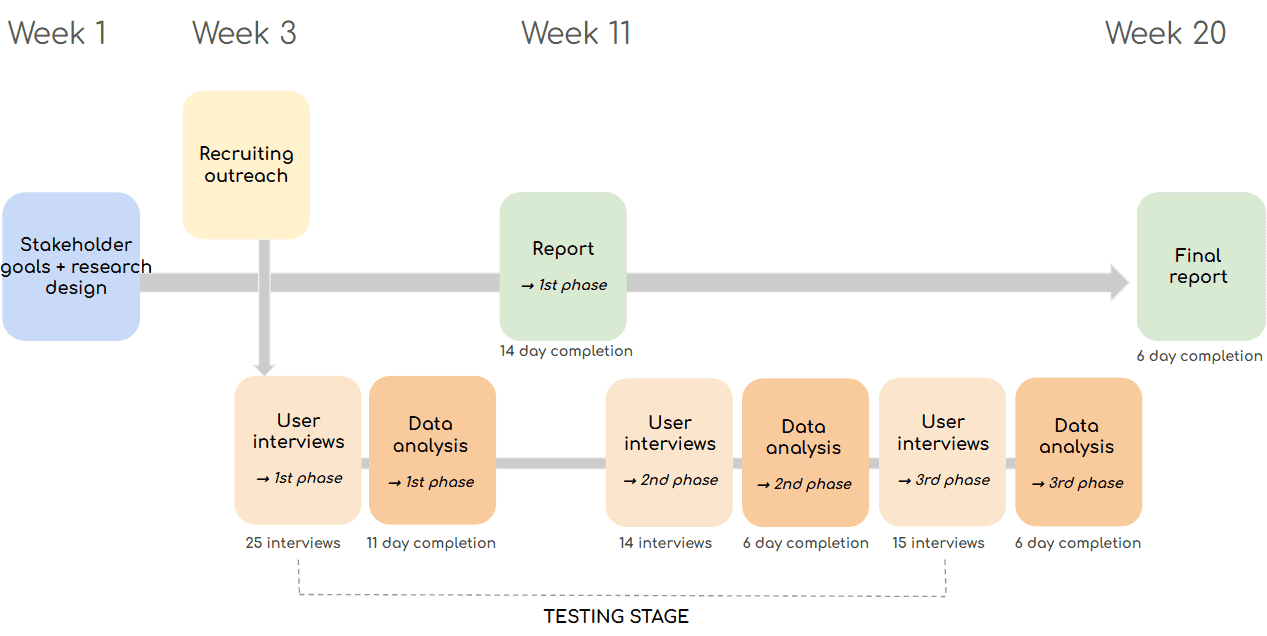
Methods
Screener Survey: Qualtrics
In-depth Interviews: Explore the value proposition and customer experiences
Moderated Usability Testing: Identify implementation pain points
A/B Testing: Compare two implementations flows to determine clarity
Affinity Mapping/Journey Mapping: Analyze insights using Figma
Thematic Coding: Google Sheets
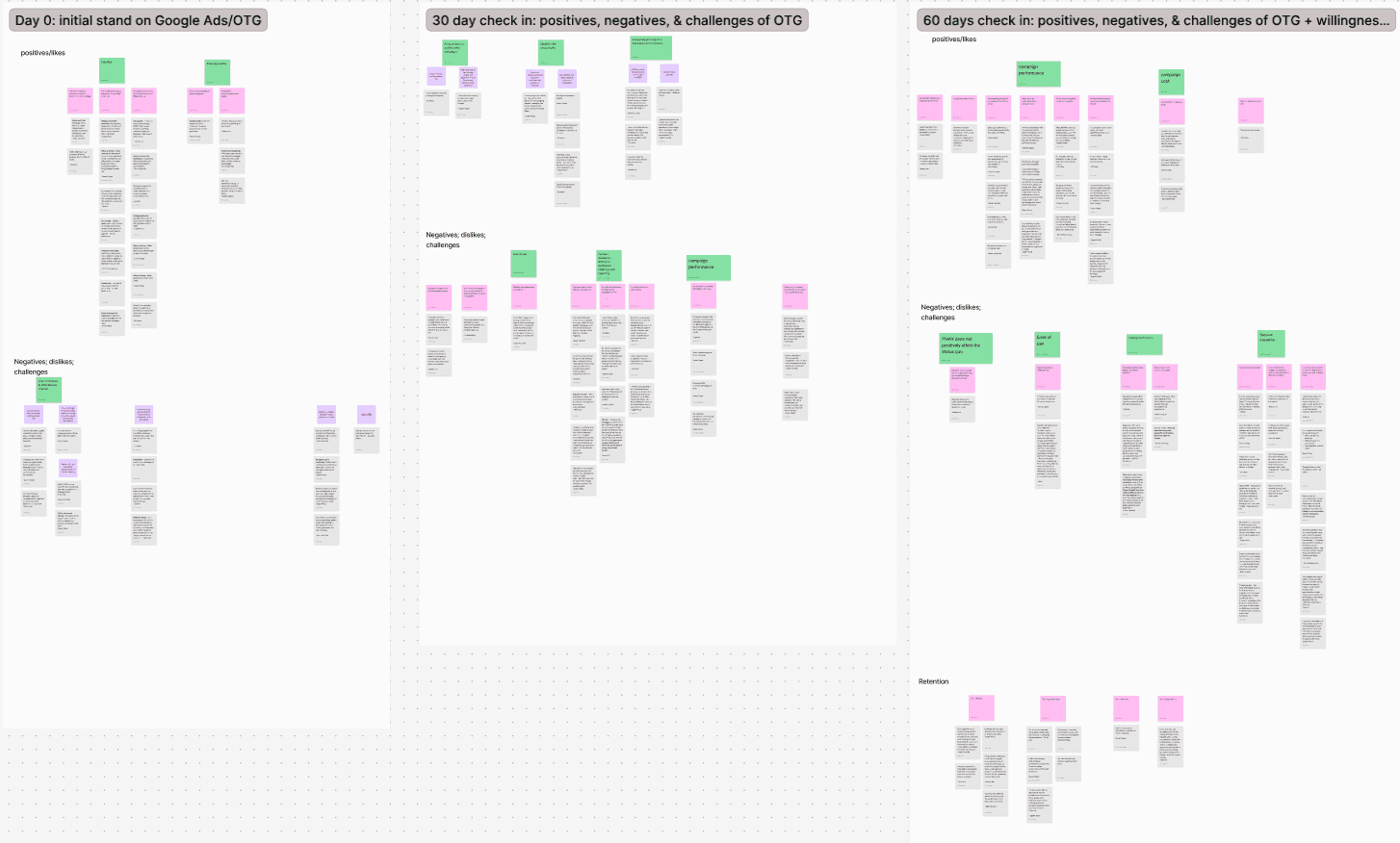
*screenshots of journey mapping on Figma
Stakeholder Alignment

Kickoff alignment: Co-defined research goals, planning, and deliverables with Product and Marketing teams.
Ongoing communication: Established comms channel across Product, Market, and Research teams sharing weekly progress updates, early insights, and raising flags.
Ad-hoc collaboration: Initiated syncs across teams to resolve blockers — clarified mismatched documentation and uninformed A/B testing.
Interim & final readout: Led presentations with another researcher, translating findings into actionable GTM recommendations and product dev roadmap decisions.
Challenges Faced

Phase One
Delayed whitelisting: Up to 11-day delays caused a 40% participant drop-off rate.
Documentation issues: Mismatched resources led to form changes and awkward flows, making it harder to assist advertisers, but resolutions were found after various challenges were encountered.
Uninformed A/B testing: A UI update caused errors in data entry for the first two calls, requiring manual corrections.
Team bandwidth: Two researchers left mid-project.
Shortened testing period: Reduced from 90 days to 60 due to whitelisting delays.
Sign-up flow issues: PMax for Store Goals campaign creation was inaccessible through the Smart Campaign flow.
Phase Two
Fewer testers: Delays and holidays (Thanksgiving, Christmas, New Year’s) impacted participation. Increasing incentives resolved this issue.
Key Findings & Recommendations

Phase One
1. Low awareness (15% of PMax for Store Goals)
Recommendation: Use email announcements and in-app pop-ups to increase awareness and adoption.
2. Misperceptions of value proposition (37% thought the targeted audience for Product X was restaurants):
Recommendation: Broaden examples in marketing materials to include diverse business types and increase product adoption.
"Honestly, I didn't think [Product X] would be that valuable since I thought it was for restaurants. It's been really valuable for us and I've noticed a lot more bookings on the day of. I love it. It's my best performing advertisement. I've put almost all my budget into this and I am really hoping that I can continue using it."
3. Visual assets clarified value proposition
Recommendation: Lead with graphic images in marketing materials to draw advertiser audience.
4. Set up challenges: 50% selected incorrect goals.
Smart campaign flow issues prevented access to Product X creation without switching to expert mode.
Recommendation: Include clear self-onboarding instructions in marketing materials.
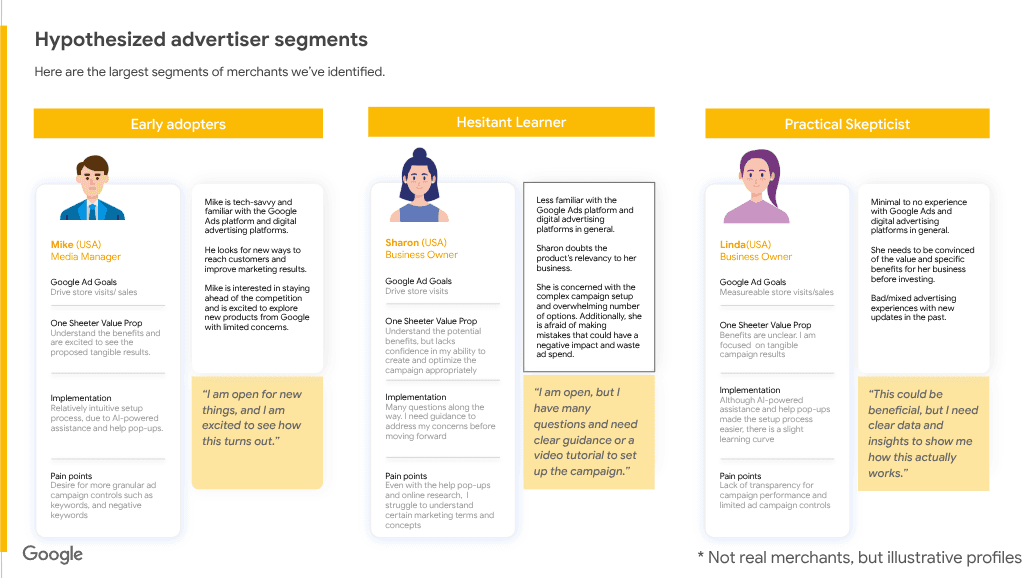
*screenshot of customer personas
Phase Two
1. Almost all advertisers happily continued to invest in Product X - and in some cases reallocated more budget!
2. Advertisers saw success superior to existing advertisements (~45 days on average).
Recommendation: Use customer stories within marketing materials to build trust and encourage adoption.
1. KPI's included sales, bookings, and order volumes—not just foot traffic.
Recommendation: Shift marketing focus to these KPIs.
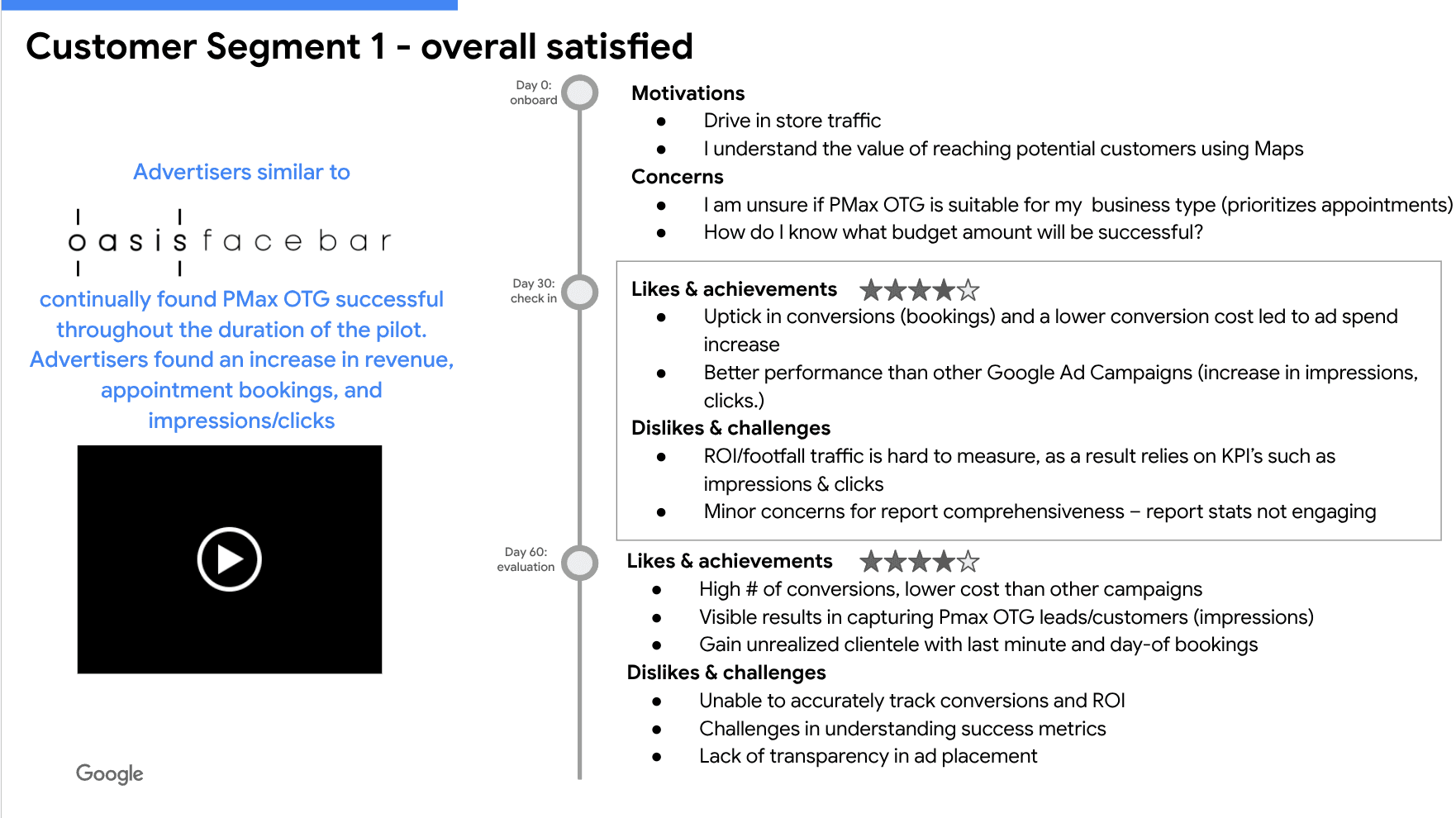
*screenshot of 1 customer segment post-testing
Top Impact

Phase One: Adoption increased by nearly 30% within two months.
Phase Two: 2 driving navigation metrics were added to measure and evaluate campaign success.
Lessons Learned & Improvements

Streamline the whitelisting process (1-3 business days) to minimize drop-offs. Alternatively, if there is no improvement in the whitelisting process, set expectations for stakeholders from the get go.
Ensure all training materials reflect the latest UI or use prototypes if necessary.
Confirm A/B testing plans before usability testing begins.
Recruit additional participants upfront to account for potential attrition.